Cloudflare R2

Best Self Hosted Alternatives to Cloudflare R2

A curated collection of the 2 best self hosted alternatives to Cloudflare R2.

Cloudflare R2 is an S3-compatible object storage service for storing and serving unstructured data with no egress fees, global distribution, low-latency access, and integration with Cloudflare Workers and CDN.

Alternatives List

#1
Syncthing

Syncthing

Open-source, secure, peer-to-peer file sync that keeps folders identical across devices without a central cloud server.
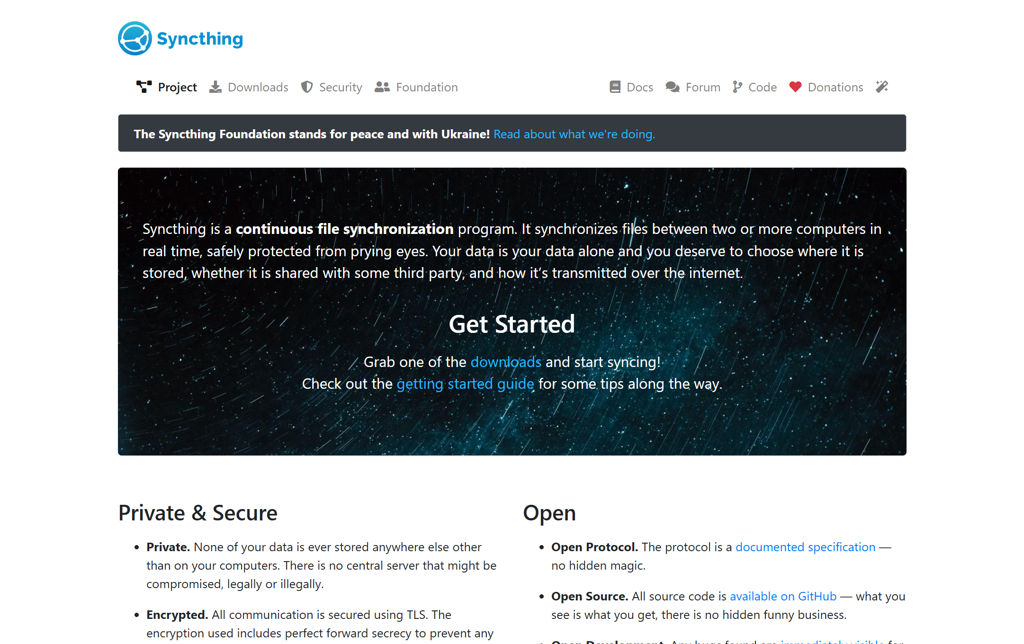
Syncthing screenshot

Syncthing is a continuous file synchronization tool that keeps selected folders in sync between two or more devices. It uses a peer-to-peer model (no mandatory central server), focusing on privacy, resiliency, and cross-platform support for desktops, servers, and mobile devices.

Key Features

  • Peer-to-peer folder synchronization between trusted devices (device IDs) without relying on a central storage provider
  • Encrypted transport (TLS) and device authentication via cryptographic device identities
  • Web-based GUI for configuration/monitoring plus a REST API and event stream for automation/monitoring integrations
  • NAT traversal and relay support to connect devices across networks (global discovery and optional relay usage)
  • Versioning options for deleted/overwritten files (simple, staggered, trash can, external)
  • Per-folder controls: ignore patterns, file/folder permissions handling, rescan intervals, selective folder sharing
  • Cross-platform binaries and packaging for common OSes; runs well on headless servers

Use Cases

  • Sync a “working files” directory between a laptop and a home server without using Dropbox/Drive
  • Keep a replicated copy of important folders across multiple machines as a lightweight redundancy layer
  • Maintain shared folders between a small number of trusted devices (e.g., family/workstations)

Limitations and Considerations

  • It is not a multi-user collaboration/groupware platform; sharing is based on explicitly trusted device pairs
  • Conflicts can occur with concurrent edits; Syncthing creates conflict copies rather than merging content

Syncthing fits users who want direct device-to-device synchronization with strong transport security and operational transparency. It’s especially useful when you want cloud-like syncing behavior while keeping storage and control on your own devices.

78.9kstars
4.9kforks

#2
MinIO

MinIO

Self-hosted, S3-compatible object storage server for cloud-native workloads with replication, versioning, encryption, and Kubernetes-friendly deployment.

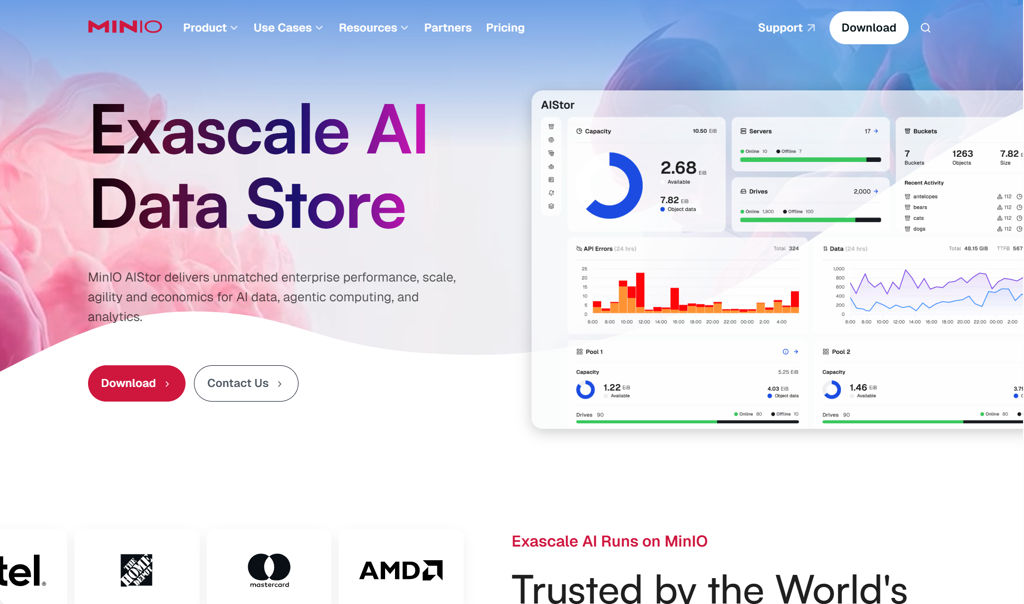
MinIO screenshot

MinIO is an open-source object storage server designed for high-performance, cloud-native and on-prem deployments. It implements an Amazon S3-compatible API, enabling applications and tools built for S3 to use MinIO as a drop-in storage backend.

Key Features

  • Amazon S3-compatible API for object storage (buckets, objects, multipart upload, presigned URLs)
  • Distributed/scale-out deployments for high availability and performance
  • Erasure coding for data protection and efficient storage utilization
  • Bucket and object versioning support
  • Replication capabilities (commonly used for site-to-site and disaster recovery scenarios)
  • Server-side encryption support (SSE) and TLS for in-transit protection
  • Identity and access management features such as policies and access keys
  • Event notifications/hooks for integrating with external systems (e.g., message queues/webhooks)

Use Cases

  • Private S3-compatible storage for applications, backups, and archives
  • Storage layer for Kubernetes and cloud-native platforms needing S3 APIs
  • Log, media, and dataset storage for analytics/ML pipelines

Limitations and Considerations

  • Object storage semantics differ from POSIX filesystems; applications may require S3-native integration
  • Distributed deployments require careful planning for networking, disk layout, and operational monitoring
  • Some advanced enterprise capabilities may depend on MinIO’s broader ecosystem and deployment choices

MinIO is commonly used to replace managed object storage when organizations need full control over data location, performance tuning, and on-prem or edge deployments. Its S3 compatibility makes it suitable for integrating with a wide range of existing tools and software that already support S3.

59.6kstars
6.9kforks

Why choose an open source alternative?

  • Data ownership: Keep your data on your own servers
  • No vendor lock-in: Freedom to switch or modify at any time
  • Cost savings: Reduce or eliminate subscription fees
  • Transparency: Audit the code and know exactly what's running