
Twilio SendGrid

Best Self Hosted Alternatives to Twilio SendGrid

A curated collection of the 5 best self hosted alternatives to Twilio SendGrid.

Twilio SendGrid is a cloud-based email delivery platform offering APIs and SMTP relay for transactional and marketing emails, plus deliverability tools, templates, analytics, and scaling to ensure reliable email delivery.

Alternatives List

#1
Novu

Novu

A self-hostable notification infrastructure to build, manage, and send multi-channel product notifications with templates, provider integrations, and a unified API.
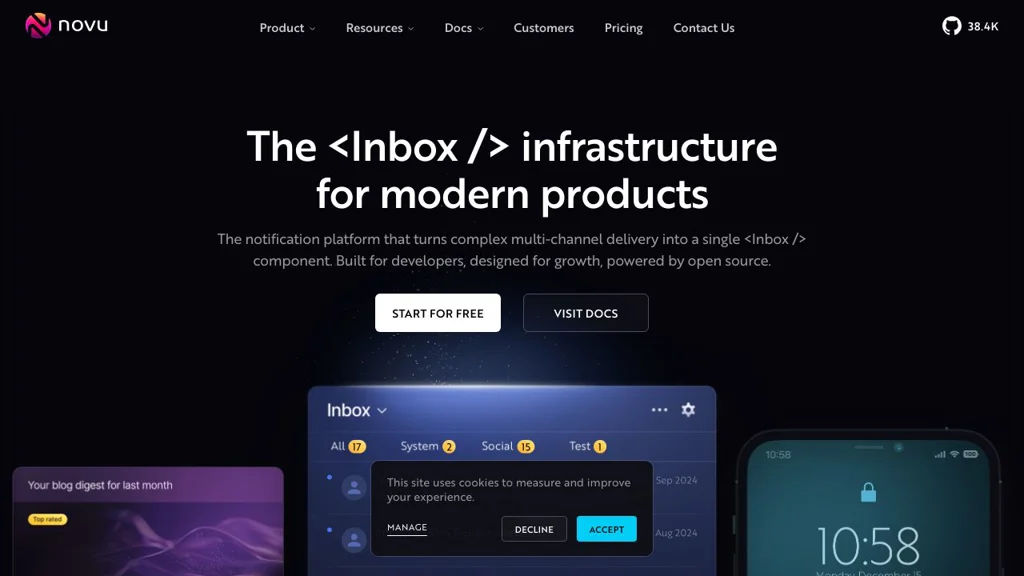
Novu screenshot

Novu is an open-source notification infrastructure platform for building and managing product notifications across multiple channels (email, SMS, push, chat). It provides a unified API and an admin UI to create notification workflows, manage templates, and route messages through many third-party providers.

Key Features

  • Multi-channel notifications (e.g., email, SMS, push, chat) from a single API
  • Template management with a web-based UI for creating and maintaining notification content
  • Provider abstraction layer to switch between delivery providers without changing application code
  • Event-triggered workflows to orchestrate notification steps and channel fallbacks
  • Subscriber/user management for targeting and routing notifications
  • Preference management concepts for controlling which notifications users receive
  • Integrations for popular messaging/notification providers (varies by channel)
  • Developer-focused SDKs and APIs for embedding notification delivery into apps

Use Cases

  • Shipping transactional notifications (sign-up, password reset, receipts) across email/SMS
  • Product alerts and lifecycle messaging with channel fallback and centralized templates
  • Building an internal notification hub to standardize delivery providers across teams

Limitations and Considerations

  • Running the full platform typically requires multiple backing services (e.g., database, cache/queue), increasing operational complexity.

Novu fits teams that want control over notification logic and templates while keeping provider integrations modular. It is especially useful when multiple apps/services need consistent notification workflows and governance from one place.

38.4kstars
4.2kforks

#2
listmonk

listmonk

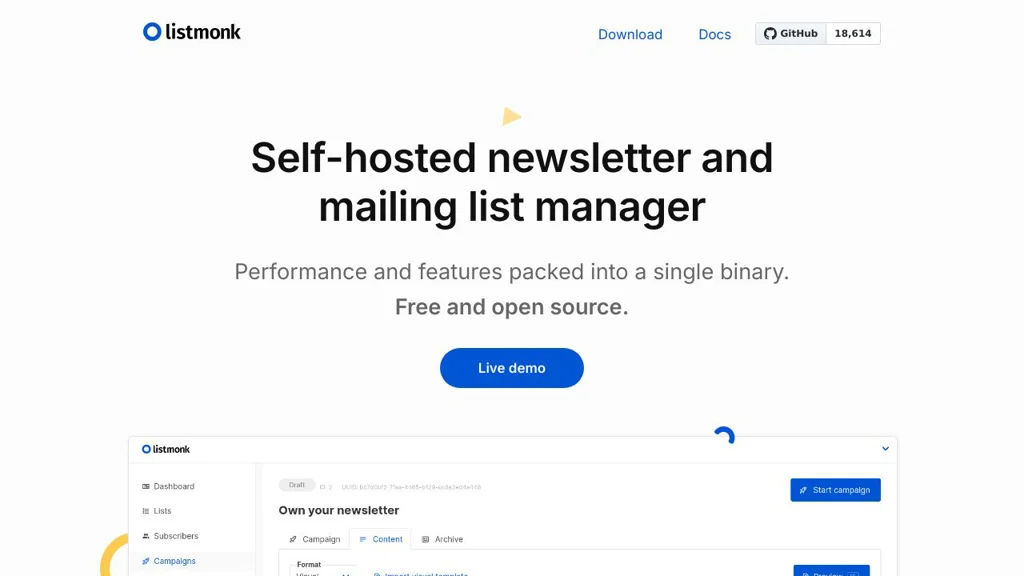
Self-hosted newsletter and email list manager with templating, segmentation, campaigns, and PostgreSQL-backed performance.

listmonk screenshot

listmonk is a self-hosted mailing list manager and newsletter platform designed for high performance and simple operations. It provides a web UI and APIs to manage subscribers, lists, and campaigns, backed by PostgreSQL for scalable storage and querying.

Key Features

  • Subscriber management with custom attributes/fields and import/export (e.g., CSV)
  • List and segment-based targeting using PostgreSQL queries for flexible filtering
  • Campaign creation with HTML templates, previews, and personalization variables
  • Transactional email and newsletter sending via SMTP and third-party email gateways
  • Bounce handling and basic list hygiene workflows (depending on mail setup)
  • Built-in admin web UI plus REST-style APIs for automation and integrations
  • Metrics/reporting for campaigns (opens/clicks) via tracking mechanisms

Use Cases

  • Send periodic newsletters to product users, communities, or customers
  • Run segmented email campaigns (e.g., onboarding, announcements) from internal data
  • Operate a privacy-controlled mailing system for organizations that can’t use SaaS

Limitations and Considerations

  • Deliverability, bounce processing, and reputation management depend heavily on your SMTP/provider configuration
  • Email template building is developer-oriented compared to drag-and-drop marketing suites

listmonk is a solid fit for teams that want a fast, PostgreSQL-driven newsletter system with a clean UI and automatable APIs. It focuses on dependable list and campaign operations rather than heavyweight marketing-automation features.

18.7kstars
1.9kforks
#3
Postal

Postal

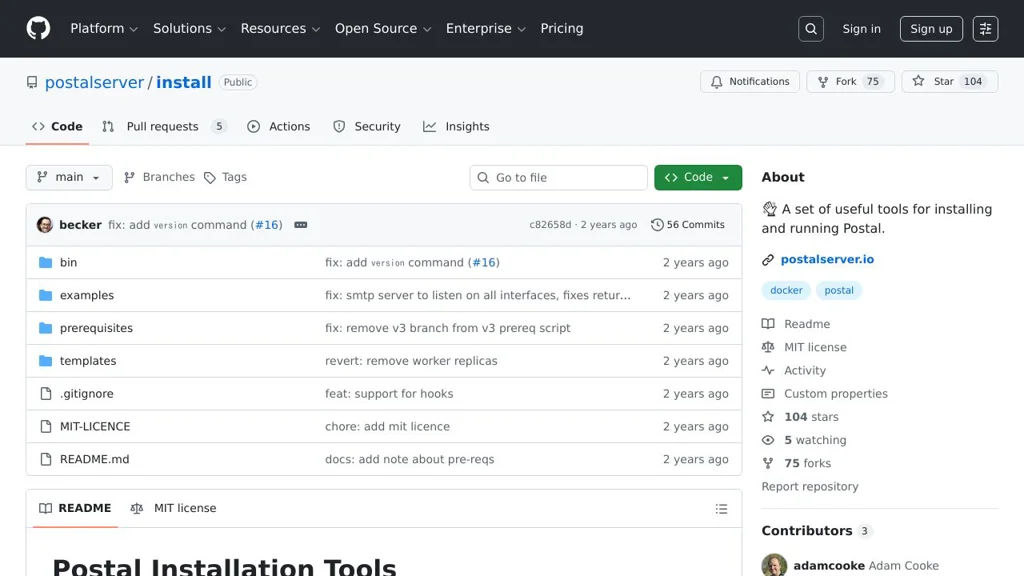
Open-source SMTP delivery platform with web UI, HTTP API, and message tracking for sending transactional email from your own infrastructure.

Postal screenshot

Postal is an open-source mail delivery platform designed for sending transactional email from applications using your own infrastructure. It provides SMTP and an HTTP API, plus a web interface to manage organizations, servers, credentials, and to inspect message activity.

Key Features

  • SMTP server for application email delivery with per-server credentials
  • HTTP API for sending messages programmatically
  • Web-based administrative UI for managing organizations/servers/users
  • Message tracking/logs for sent mail, including delivery attempts and status
  • Support for multiple “mail servers” and separation by organization/team
  • Domain and routing configuration tooling oriented around transactional mail

Use Cases

  • Replace third-party transactional email providers for product emails (signups, password resets, receipts)
  • Centralize outbound mail delivery for multiple apps/services with separate credentials
  • Operate an internal email relay with auditing/visibility into outbound messages

Limitations and Considerations

  • Primarily focused on outbound/transactional delivery (not a groupware mailbox server)
  • Requires correct DNS and deliverability configuration (SPF/DKIM/DMARC) and ongoing reputation management

Postal is suitable when you need control over outbound email delivery, want an API/SMTP interface for applications, and need a UI for operational visibility. It provides the core primitives for delivering and tracking mail without relying on hosted email-sending services.

16.2kstars
1.2kforks
#4
Mail-in-a-Box

Mail-in-a-Box

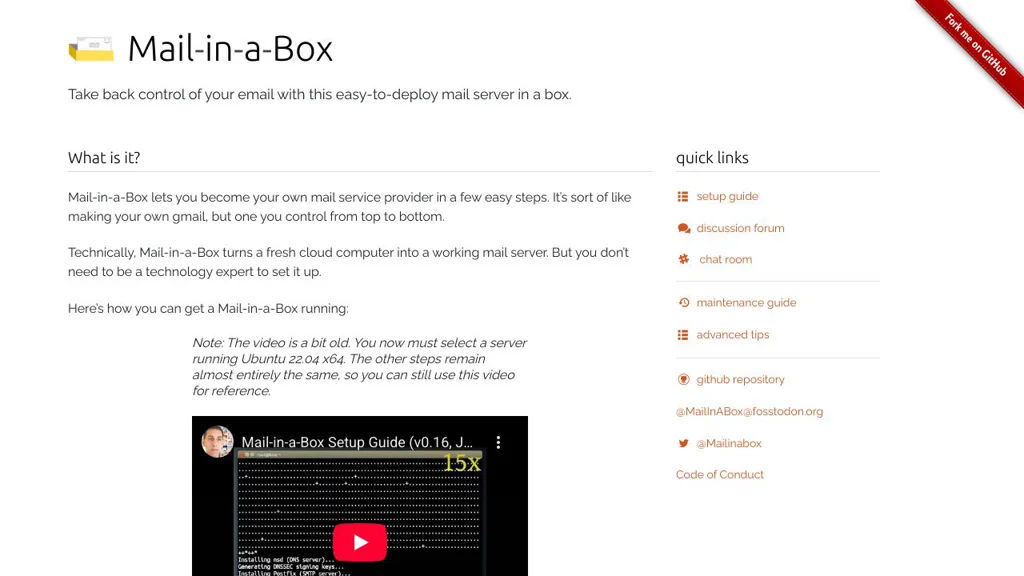
Turn a fresh Ubuntu server into a complete mail server with webmail, DNS, spam filtering, automatic TLS, and an easy-to-use admin control panel.

Mail-in-a-Box screenshot

Mail-in-a-Box is an opinionated all-in-one setup that turns a fresh Ubuntu server into a working email system for your domain(s). It bundles the core components needed to run mail reliably (sending/receiving, security, spam filtering, DNS, and webmail) and manages them through a simple web-based control panel.

Key Features

  • One-command installation on a supported Ubuntu release (designed for a clean VPS)
  • Admin control panel for users, aliases, domains, and service status
  • Integrated webmail (Roundcube) plus IMAP/SMTP support for desktop/mobile clients
  • Built-in DNS server/management to publish required records (MX, SPF, DKIM, DMARC, etc.)
  • Automatic TLS certificates via Let’s Encrypt (ACME) for HTTPS/IMAPS/SMTPS
  • Spam filtering and basic anti-abuse tooling (e.g., greylisting/antispam integration)
  • Contact/calendar sync support via CardDAV/CalDAV (via bundled groupware components)

Use Cases

  • Host email for a personal domain or small organization without outsourcing to a provider
  • Replace hosted email suites for basic mail + webmail needs
  • Provide mailboxes and aliases for multiple domains from a single server

Limitations and Considerations

  • Opinionated stack and OS support: intended for a specific Ubuntu version on a clean server
  • Advanced enterprise features (large-scale clustering, complex compliance tooling) are not the primary focus

Mail-in-a-Box is a practical choice when you want a complete, integrated mail setup with sane defaults and a straightforward admin experience. It emphasizes simplicity and a cohesive configuration over modular, pick-and-choose assembly.

15.1kstars
1.5kforks
#5
Stalwart Mail Server

Stalwart Mail Server

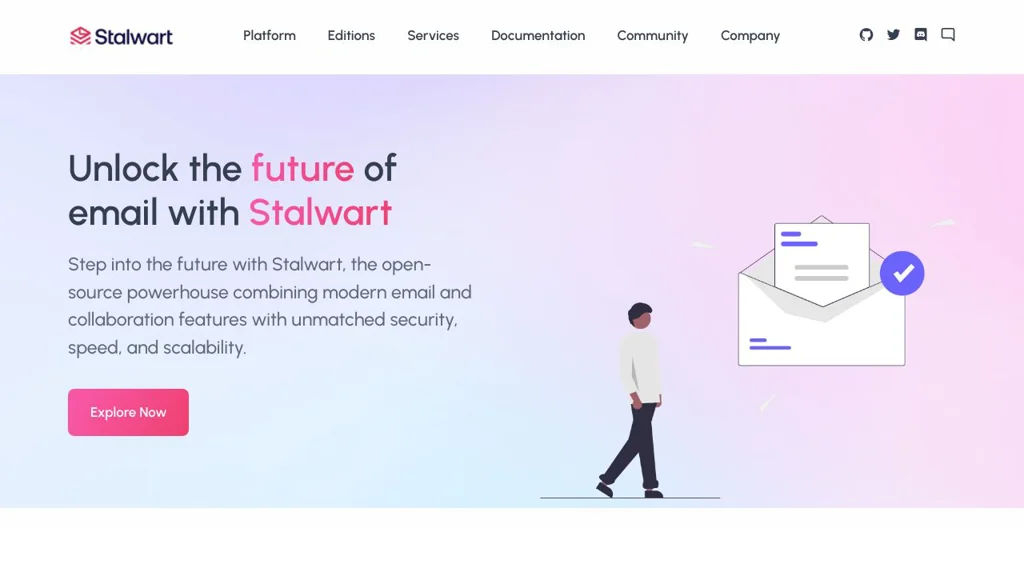
Stalwart is an all-in-one mail server (SMTP/IMAP/JMAP) with built-in anti-spam/DMARC, web admin UI, and flexible routing for running your own email infrastructure.

Stalwart Mail Server screenshot

Stalwart is a modern, self-contained email server designed to run a complete mail stack (sending, receiving, and mailbox access) with strong security controls and built-in filtering. It aims to simplify operating mail infrastructure by bundling protocols, authentication, policy, and anti-abuse features into a single service with an administrative UI.

Key Features:

  • Supports core mail access and transport protocols including SMTP and IMAP, with JMAP support for modern clients
  • Built-in anti-spam and policy enforcement with rules, reputation controls, and content filtering
  • Email authentication features such as DKIM signing and DMARC/SPF evaluation to improve deliverability and prevent spoofing
  • Flexible message routing, domain/user management, and multi-domain support for organizations
  • Web-based administration interface for configuration and operational management
  • TLS support and modern security defaults oriented toward safer deployments

Use Cases:

  • Run a private email service for a personal domain or small organization
  • Replace a hosted mailbox provider while keeping control of deliverability and anti-spam
  • Operate multi-tenant email for multiple domains with centralized management

Stalwart provides a cohesive, security-focused approach to running email by combining protocols, filtering, and administration in one package. It is well-suited for operators who want a modern mail stack with fewer external components to integrate and maintain.

11.1kstars
600forks

Why choose an open source alternative?

  • Data ownership: Keep your data on your own servers
  • No vendor lock-in: Freedom to switch or modify at any time
  • Cost savings: Reduce or eliminate subscription fees
  • Transparency: Audit the code and know exactly what's running