The Real Cost of Building Video Infrastructure In-House
Video infra costs break into 3 categories, not 1. See the real 3-year TCO of building vs. buying, plus the break-even point most teams miss.
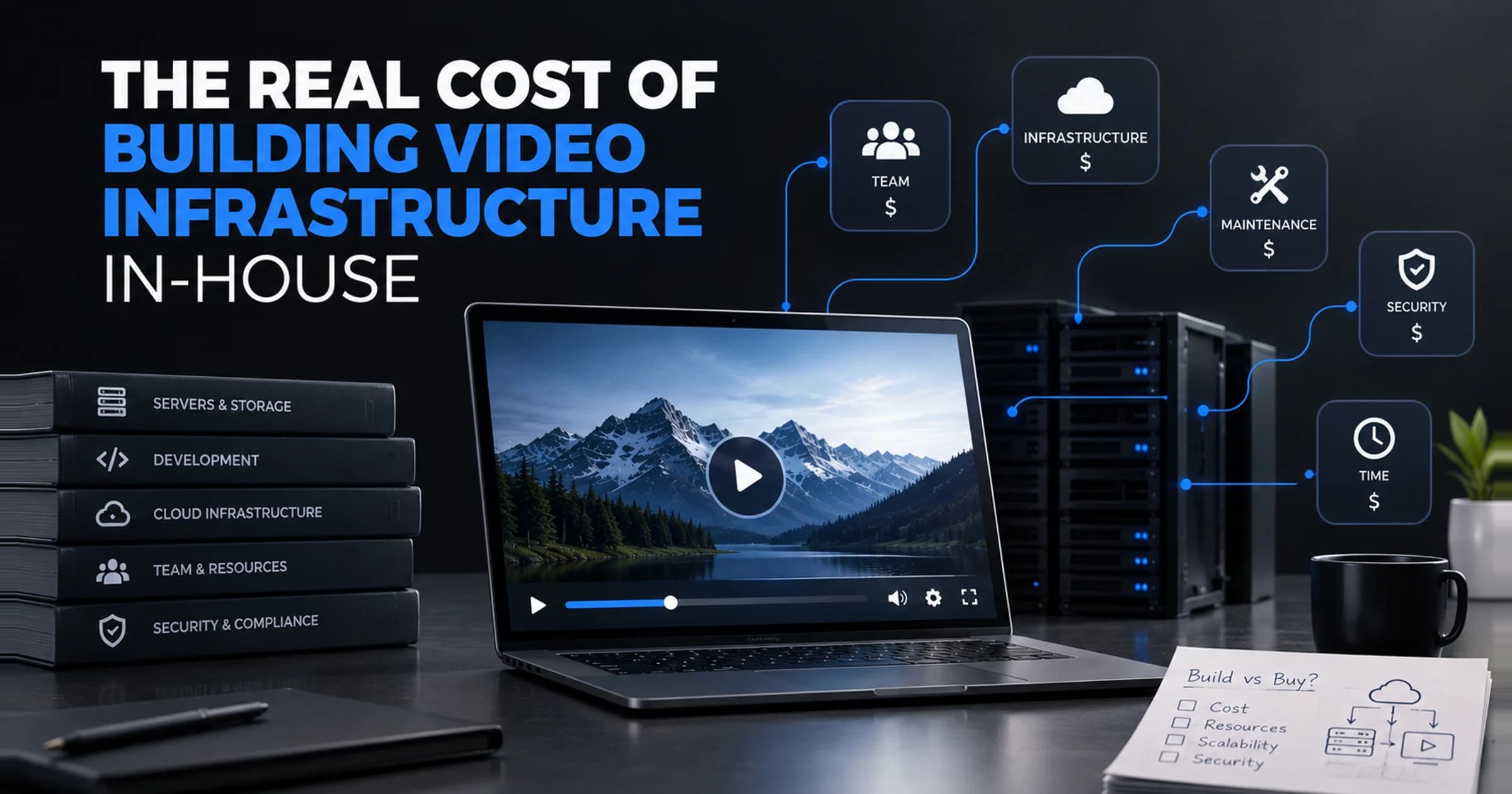
A mid-market SaaS company I worked with last year had already made the call before anyone outside engineering saw a number. Video was becoming central to how they onboarded customers, someone pulled up the AWS pricing calculator, plugged in a rough estimate for storage and CDN, and the monthly figure came back under $2,000.
That number went into the board deck. Nine months later, the actual run rate on video was closer to $340,000 a year, and almost none of it was the cloud bill.
That gap is the subject of this article. Video infrastructure cost breaks into three categories, not one: the cloud infrastructure bill, the engineering team required to run it, and the security layer required to protect it. Most teams price only the first one, and the first one is usually the smallest.
This article walks through what each category actually costs at real scale, states the specific threshold where building in-house starts to make financial sense, and gives you the questions to ask before anyone signs off on a build.
If you're the one who has to defend the number to a board or a CFO, this is the version of that conversation with the parts usually left out put back in.
Key Takeaways
- Raw cloud infrastructure for video (CDN, storage, transcoding) is the smallest of three cost categories, typically running $200 to $15,000 a month depending on viewer scale, and it's the only one most teams actually price before greenlighting a build.
- A team capable of running that infrastructure safely costs $150,000 to $500,000 or more a year in fully loaded engineering salary, a cost that rarely appears in the initial estimate at all.
- Content security, specifically DRM, signed URLs, and watermarking, is the line item almost every build estimate omits, and standalone DRM integration alone runs an estimated 20 to 60 engineering hours on a first build.
- The break-even point where self-hosting becomes cheaper than a managed platform sits in the tens of millions of viewer-hours a year for general video delivery, a scale far above most SaaS, EdTech, and media companies weighing this decision.
- Three-year total cost of ownership for an in-house build, once engineering and security are counted, commonly runs 3 to 8 times higher than a comparable all-in-one managed video hosting platform, the kind that bundles delivery, protection, and analytics, at the same traffic level.
- The decision is reversible in one direction only: a growing team can start on an all-in-one managed platform and build later once usage justifies it, but a team that builds first and needs to buy later is looking at a migration, not a clean start.
What Does It Actually Cost To Build Video Infrastructure In-House?
Building video infrastructure in-house costs three separate bills:
- The cloud infrastructure itself (transcoding, storage, CDN delivery)
- The engineering team required to build and run it
- The security tooling required to protect the content once it's live
At a moderate scale of around 10,000 concurrent viewers on video-on-demand delivery, raw AWS-class infrastructure runs $10,000 to $15,000 a month, according to cost modeling from a 2026 cloud-cost research firm SpendArk.
A team capable of running that infrastructure safely runs $150,000 to $500,000 or more a year in loaded salary, based on Fora Soft's 2026 published engineering-cost estimates for production video platforms.
Put those next to each other and the ratio is the whole story: infrastructure is the visible tip, engineering is the mass underneath it that never makes the first slide.
One-time build costs and recurring monthly costs are different questions, and most estimates blur them. A basic web VOD MVP, meaning upload, transcoding, adaptive playback, and analytics, runs $30,000 to $60,000 to build and roughly $300 to $700 a month to host once it's live. That build figure is a one-time capital cost. The monthly figure recurs forever, and it grows with usage, headcount, and every security requirement added after launch.
Total cost of ownership, the combined figure that includes build cost plus every recurring cost over a stated period, is the number that actually matters for a build decision. A single-project build estimate answers "what will this cost to ship." TCO answers "what will this cost to own," and ownership is what a build decision actually commits a company to.
I've spent the past year evaluating video infrastructure options for SaaS and EdTech clients, testing all-in-one managed platforms like Gumlet alongside API-first and security-first alternatives such as Mux and VdoCipher, and raw cloud builds on AWS. That work means the examples below skew toward what shows up repeatedly in that evaluation process.
Independent cost research from SpendArk and Fora Soft, cited throughout, points in the same direction on the numbers that matter most, so the pattern isn't just a vendor-adjacent observation. Where the evidence disagrees with the tidy version of this story, I've said so.
How Much Does Video Bandwidth and CDN Delivery Actually Cost?
CDN egress, the cost of delivering video from the content delivery network to each viewer, is the single largest line item in any video infrastructure budget, and it typically accounts for 60 to 95 percent of total monthly infrastructure spend once a platform has real traffic.
At 10,000 concurrent viewers watching 1080p video, CDN egress alone runs $8,000 to $15,000 a month depending on provider and region.
The mechanism is straightforward: One viewer watching 1080p video at a 4 Mbps average bitrate transfers roughly 1.8 GB per hour. Multiply that by viewer count and session length, and the number stops looking like a rounding error fast.
| Concurrent viewers | Approx. monthly CDN transfer | Approx. total monthly infra cost |
|---|---|---|
| 100 | 0.65 TB | $140 to $220 |
| 1,000 | 6.5 TB | $1,100 to $1,800 |
| 10,000 | 65 TB | $10,000 to $15,000 |
| 100,000 | 650 TB | $85,000 to $130,000 |
Figures reflect AWS US-East-1 standard rates, 1080p at 4 Mbps average bitrate, 8-hour daily peak concurrency, video-on-demand delivery, based on SpendArk's 2026 analysis.
The provider you pick changes the bill by an order of magnitude on identical traffic. At 500 TB of monthly delivery, the same bytes cost roughly $42,500 a month on AWS CloudFront and closer to $2,500 to $5,000 on Bunny, a video-first CDN. That's not a rounding difference; it's the gap between a line item and a budget crisis, and it's decided by a CDN contract, not by the code.
Live streaming multiplies this further: Live video typically costs 3 to 6 times more per viewer-hour than on-demand delivery of the same content, because live segments refresh every 2 to 10 seconds and the CDN cache hit rate drops from 85 to 95 percent for VOD down to 30 to 60 percent for live.
If your roadmap has any live component, price it separately from the VOD number, because folding the two together is how a "$2,000 a month" estimate quietly becomes $7,500.
One thing worth flagging before you model this yourself: A traffic spike doesn't just raise the bill, it raises it on infrastructure that was sized for average load. A platform running comfortably at 1,000 concurrent viewers that suddenly hits 10,000 during a launch or a viral moment isn't paying 10x the cost. It's paying 10x the cost on top of origin servers and monitoring that were never built for that ceiling, which is where outages happen, not just overages.
How Much Does Transcoding and Storage Cost, and Who Has to Own it When it Breaks?
Transcoding, the process of converting one uploaded video into multiple resolutions for adaptive playback, is genuinely the cheapest layer in the stack.
A one-hour source file transcoded into a standard seven-rendition ABR ladder costs roughly $4.95 on AWS MediaConvert, or about $3.30 on GCP's Transcoder API, which prices HD output around 33 percent cheaper. Storage follows the same pattern: a 1,000-hour content library costs around $1,495 a month in raw S3 storage before any lifecycle tiering.
Codec choice barely moves this needle at moderate scale. H.264 remains the universal baseline for browser and device compatibility; HEVC and AV1 offer better compression but cost more to encode and require testing across a wider device matrix. For most SaaS product demo libraries or EdTech course catalogs under a few thousand hours, this is a one-paragraph decision, not a project.
Here's the part the cloud pricing page doesn't show: transcoding is a one-time cost per asset, but every codec transition, every browser update, and every playback bug that shows up on one specific device combination is a recurring cost paid in engineering hours, not dollars.
That's a different kind of expensive. A platform that transcodes 100 hours of new content a month for $500 to $1,000 in raw compute still needs someone who understands why a specific Android device is dropping frames on HEVC playback, and that someone is a senior engineer, not a line item.
This is where the "who owns it" question stops being abstract. Storage and transcoding accumulate quietly. An encoding pipeline running two years without a lifecycle policy can hold 50 to 200 TB of segments costing $1,150 to $4,600 a month, often for content nobody has watched in a year. Nobody notices until someone asks why the S3 bill doubled, and by then the person who set up the pipeline may not even be on the team anymore.
What Does CDN Egress Actually Cost Compared to Everything Else?
CDN egress is the largest single line item in video infrastructure spend, typically accounting for 50 to 70 percent of total monthly infrastructure cost at scale, according to 2026 cloud-cost modeling from SpendArk.
That share grows with viewer count, not shrinks. At the 100-viewer tier, egress is a minor part of an already-tiny bill. At 100,000 concurrent viewers, egress alone can reach $85,000 to $130,000 a month, roughly 70% of total infrastructure spend before volume discounts apply.
Transcoding and storage, by comparison, stay flat or grow slowly, because they're driven by catalog size, not audience size. A library doesn't get more expensive to store because more people watch it.
This is the part of the infrastructure bill that responds to architecture decisions. Per-title encoding, cache-header tuning, and storage lifecycle policies can each cut five figures a month off a 10,000-viewer platform's egress and storage costs without touching engineering headcount.
The three biggest levers, in order of impact: per-title encoding (20 to 40 percent savings on CDN egress), tuned cache headers on VOD segments (savings scale with catalog depth), and storage lifecycle tiering (moving unwatched content out of standard storage after 90 days).
How Many Engineers Does it Take to Run Video Infrastructure, and What Does That Actually Cost?
Running production video infrastructure requires a dedicated team, not a side project for whoever's available. Fora Soft, a video engineering firm that has shipped 250-plus streaming products since 2005, puts the fully loaded run rate for a large custom video platform at $720,000 to $1.8 million a year for an 8 to 10 person team, and recommends two to three dedicated engineers as the minimum commitment for a build path over three years.
At a moderate scale, that's a wide range depending on how much of the stack you're building versus assembling from managed cloud services.
Three engineers at a blended fully loaded cost of $150,000 to $180,000 a year runs $450,000 to $540,000 annually before a single CDN invoice arrives, and that's the floor for a team that owns encoding, delivery, and security together.
That range is bounded, and the boundary matters. It applies to teams building real-time or scale-sensitive video products where the infrastructure is genuinely complex.
A smaller VOD-only build for a SaaS product demo library needs fewer people, but the floor is still a dedicated owner, not a fractional one, because video infrastructure doesn't tolerate being nobody's full-time job.
Can you run self-hosted video without a DevOps team? No. Self-hosting requires ongoing maintenance: security patches, CDN configuration, encoding pipelines, monitoring.
That line lands because it's the exact question nobody asks in the planning meeting. Everyone asks what it costs to build. Almost nobody asks who gets paged at 2am when the encoding queue backs up during a product launch, and that gap is where the real budget lives.
The opportunity cost compounds the direct cost, and no cloud calculator shows it. Every engineer maintaining the video pipeline is an engineer not shipping the feature that actually differentiates the product.
For a company where video supports the business rather than being the business, that's the cost that should end the conversation fastest: three to six senior engineers spending a year on transcoding queues and CDN failover instead of the roadmap the company actually sells.
The number that reframes the whole decision: At 10,000 viewers, raw infrastructure runs roughly $10,000 to $15,000 a month, or $120,000 to $180,000 a year. A team of three engineers capable of running that infrastructure safely costs $450,000 to $540,000 a year at minimum, and scales toward $720,000 to $1.8 million a year for a larger team running a full custom stack. Infrastructure is the visible fraction of the real cost. Engineering is most of what never makes the pricing calculator.
What Does Content Security Add to the Cost of Building In-House, and Why Does Almost No Cost Estimate Include It?
For a SaaS company protecting product demos or an EdTech platform protecting paid course content, this is exactly the line item that turns a "reasonable" build estimate into an expensive lesson after the first incident.
Building DRM in-house is not a checkbox, it's a stack. Certified Widevine and FairPlay DRM alone requires license server integration, device testing across Android, iOS, Chrome, and Safari, and key management that has to stay current as each platform updates its requirements.
Fora Soft, which has shipped DRM-protected streaming products since 2010, estimates three to six weeks of engineering time for a full multi-DRM build, including test passes across iOS, tvOS, and other target platforms.
One detail catches most teams off guard: that cost doesn't multiply per DRM system. A single file encrypted once with Common Encryption serves Widevine, FairPlay, and PlayReady simultaneously, so shipping three DRM systems instead of one adds audience reach, not integration cost.
Signed URLs are a separate control from DRM, and conflating the two is a common and expensive mistake. A signed URL is a time-limited, cryptographically signed link that restricts who can request a video stream at all.
DRM, by contrast, encrypts the content itself and controls playback through a license, meaning even someone who obtains the file can't play it without a valid key. A platform needs both, layered, not one standing in for the other.
The realistic security stack for paid or gated video content looks like this:
- Password protection and geo-blocking as the baseline, cheap to build, easy to bypass on their own
- Domain restriction and signed URLs to control which sites and apps can request playback
- Dynamic watermarking, which embeds a viewer-specific identifier in the video so a leaked recording can be traced back to the account that leaked it
- DRM (Widevine and FairPlay) to encrypt the stream itself and control playback through a license
Each layer answers a different question. Domain locks and signed URLs decide who's allowed to press play. DRM decides whether the stream can be decrypted at all. Watermarking decides what happens after a leak, since it deters the leak and makes it traceable rather than preventing it outright.
None of these substitutes for the others, and building all four from scratch is a materially different project than building one.
What Does a Leaked Course or Product Demo Actually Cost?
A leaked course or product demo costs more than the security stack that would have prevented it, and that comparison is usually invisible until after the leak happens.
EdTech platforms report increased investment in video security specifically because unauthorized downloads, screen recording, and password sharing have become routine enough to threaten course revenue directly, not just brand reputation.
For a SaaS company, the equivalent risk is a competitor or a prospect's procurement team getting an unpaywalled look at a product demo that was supposed to be gated behind a sales conversation.
Security is also where "build vs buy" stops being a pure infrastructure question and becomes a risk question. A managed platform that ships DRM as a one-click, no-code add-on is compressing 20 to 60 engineering hours plus ongoing license management into a monthly line item.
That's the trade a lot of teams underweight when they price a build against a subscription: they're comparing a partial build estimate against a platform that already includes the layer most partial estimates leave out.
If you're at the stage of actually pricing this decision against a managed alternative, most platforms publish transparent per-plan pricing with the security add-ons broken out separately, which makes the infrastructure-versus-engineering-versus-security comparison a lot easier to run honestly than backing into it from an AWS calculator.
Build vs. Buy: Where is the Actual Break-Even Point?
The break-even point where owning the pipeline becomes cheaper than a managed platform is not a viewer-hours figure, it's an audience-size one, and Fora Soft's own worked comparison puts it between roughly 100,000 and a few hundred thousand engaged viewers, depending on bitrate and how much the managed platform marks up delivery. Below that range, buying is the rational choice on cost alone, not just convenience.
DRM follows a different logic entirely. Because encrypting once with Common Encryption serves all three major DRM systems from the same file, the crossover for self-hosted DRM isn't about system count, it's about license request volume against a managed vendor's per-request pricing.
At high volume, roughly ten million license requests a month, a negotiated per-request rate can save six figures monthly over retail pricing, which is where a self-hosted license server starts to pay for itself.
Both thresholds share a condition that's easy to miss: they assume the team already exists. A break-even calculation that only counts the marginal cost of running infrastructure on top of an already-staffed team is a different number than the cost of building that team from zero to support a single project.
Below the threshold, and without an existing team, buying wins on cost every time, not just on convenience.
Choose to build when video is the core product, not a supporting feature, usage already clears the stated threshold, and a dedicated video infrastructure team already exists on payroll.
Choose to buy when video supports the product rather than being the product, the team's engineering bandwidth is better spent on what customers actually pay for, and predictable usage-based cost is more useful than an open-ended engineering commitment.
Neither answer holds when usage is sitting right at the threshold and about to change, which is the one scenario worth re-running the numbers on every quarter rather than deciding once and forgetting it.
Is This a Build, Buy, or Hybrid Decision?
Most build-vs-buy coverage frames this as two options. In practice there's a third path that fits more teams than either extreme: hybrid, where you license the undifferentiated heavy lifting (encoding, DRM, CDN, analytics) from a managed vendor and build only the layer that's actually specific to your product.
Choose full build when video is the product itself, not a supporting feature, the team already has two to three dedicated engineers committed for three-plus years, and monthly egress is approaching or past 100 TB, the point where a self-negotiated CDN contract typically beats a vendor's bundled bandwidth allowance.
Choose hybrid when one or two specific requirements, a custom SSO flow, a particular player UX, a regional data residency rule, don't fit what a managed platform offers out of the box, but the rest of the stack is standard. This is the right call for most mid-market teams: the vendor absorbs encoding, DRM, and CDN at bulk rates, and engineering time goes only where it changes the product.
Choose buy outright when video supports the business rather than being the business, and the checklist is standard: SOC 2, GDPR, and predictable usage-based pricing cover what's actually needed.
A Three-Year Total Cost of Ownership Comparison
At a representative 10,000-concurrent-viewer scale, here's what three years actually costs across the two paths, drawing on the engineering and infrastructure figures cited throughout this article:
| Cost category | In-house build (3-year) | Managed platform (3-year) |
|---|---|---|
| Engineering (build + maintenance) | $1.7M to $4.5M | Not applicable |
| Infrastructure (CDN, storage, transcoding) | $360K to $540K | Included in platform fee |
| Security (DRM build or add-on) | $30K to $80K setup + $18K to $54K run | $99/month add-on, roughly $3.6K |
| Estimated 3-year total | $2.1M to $5.1M | Low-to-mid five figures to low six figures, scaling with usage |
In-house figures are derived from the engineering, infrastructure, and DRM cost ranges cited earlier in this article. For comparison, Fora Soft's own three-year total cost of ownership model for a mid-market enterprise video platform puts a fully custom build at $750,000 to $1.8 million over three years against $550,000 to $1.4 million for a managed platform in the same period, a gap of roughly 1.3 to 2 times, not 3 to 8 times.
The wider multiplier in the table above reflects a larger-scale, DRM-inclusive build than Fora Soft's baseline scenario; treat both as directional ranges to be re-run against your own usage before budgeting.
The gap in that table is the entire argument of this article compressed into one row. It isn't that managed platforms are cheaper in some abstract sense. It's that the in-house column contains three cost categories and the managed column collapses two of them into a subscription, which is exactly the comparison most teams never run because they only ever priced the first column's first row.
When Does Building In-House Actually Make Sense?
Building in-house makes sense in a narrower set of conditions than most engineering teams assume going in. It's the right call when video is the company's actual product, not a feature that supports the product, when usage already clears several million viewer-hours a year, when a dedicated video infrastructure team already exists rather than needing to be hired for this specifically, and when the platform needs a capability no managed API currently offers.
Outside those conditions, the honest recommendation is to buy, ship, and revisit the build question in a year once real usage data exists. That's not a hedge. It's the same advice the break-even math above supports on its own: below the threshold, the crossover doesn't happen no matter how the internal team feels about owning the stack.
What Should You Ask Before Approving a Video Infrastructure Build?
Before signing off on an in-house video infrastructure build, run the decision through eight questions, in order:
- Is video the core product, or a feature that supports the product?
- What specific control does the team need that a managed API genuinely can't provide?
- What does the full three-year total cost of ownership look like, including engineering and security, not just infrastructure?
- Who owns the on-call rotation when the pipeline breaks at 2am, and is that person already hired?
- What traffic scale justifies a fixed engineering headcount, and is the team actually near that scale today?
- Which security features (DRM, watermarking, signed URLs) are non-negotiable for this content, and what does building each one cost in engineering hours?
- What happens to the cost model if usage grows 10x in the next 18 months?
- What would the engineers building this infrastructure be building instead, and what's that worth?
If more than two of those don't have a confident answer in the room, the build isn't ready to be approved. That's not a soft recommendation, it's the practical version of the break-even math: an unanswered on-call question or an unbudgeted security line is exactly how a $2,000-a-month estimate becomes a $340,000-a-year reality.
Which Option is Actually the Holistic Choice?
Once the three cost categories are on the table together, the practical question stops being "build or buy" in the abstract and becomes "which platform actually replaces all three, not just the infrastructure bill."
That distinction matters because a lot of the "buy" side of this comparison isn't a single subscription either. An API-first platform like Mux handles encoding and delivery well but leaves marketing features, lead capture, and the full protection stack to be assembled separately.
A security-first product like VdoCipher covers DRM and watermarking thoroughly but isn't built to also run video SEO, analytics, or CTA-driven lead capture.
Stitching three vendors together to replace one in-house build is still three relationships to manage, three invoices to reconcile, and three integration points that can each break independently, even if none of them requires an engineer on-call at 2am the way a from-scratch build does.
The platforms that come closest to collapsing all three cost categories, infrastructure, protection, and the marketing and analytics layer that turns video into something measurable, into one subscription are the ones worth shortlisting first.
Gumlet is an all-in-one video hosting platform that is one of the clearer examples of this, and it's worth naming specifically because the security stack described earlier in this article, password protection and geo-blocking on every plan, domain restriction from the Creator tier, signed URLs from the Growth tier, dynamic watermarking on Business and above, and one-click Widevine and FairPlay DRM as a paid add-on, maps almost line for line onto the layered protection model this article laid out, without requiring the 20 to 60 engineering hours a from-scratch DRM integration takes.
The same subscription also covers adaptive streaming, video hosting and delivery, an ad-free branded player, lead capture and CRM integration, and analytics, the marketing layer that rarely gets counted because most teams never priced it as infrastructure in the first place.
That doesn't make it the only reasonable choice. A team already running dedicated video engineers at real scale, or one with a single narrow requirement no managed platform covers, has legitimate reasons to look elsewhere or build.
But for the SaaS, EdTech, and media teams this article has been written for, the ones weighing a build because the AWS calculator returned a number that looked manageable, the honest comparison is rarely infrastructure vendor against infrastructure vendor. It's one subscription against three cost categories that were never going to fit on a single invoice to begin with.
Enterprise teams evaluating this at higher volume, where SSO, dedicated support, and custom CDN contracts start to matter, have a separate enterprise-tier conversation worth having directly with a platform rather than trying to answer it from a general pricing page.
Frequently Asked Questions
How much does it cost to build video infrastructure in-house?
Building video infrastructure in-house costs three separate categories: raw cloud infrastructure, which runs $200 to $15,000 a month depending on viewer scale, engineering headcount, which runs $150,000 to $500,000 or more a year for a team capable of running it safely, and security tooling, which is the category most estimates skip entirely.
At 10,000 concurrent viewers, total year-one cost including engineering commonly lands between $700,000 and $1.7 million, not the $120,000 to $180,000 the infrastructure bill alone suggests.
At what point does self-hosting video become cheaper than a managed platform?
Self-hosting becomes cheaper than a managed platform at roughly 20 million viewer-hours a year for general video delivery, and for DRM specifically the crossover sits closer to 5 million license requests a month. Both thresholds assume a dedicated video infrastructure team already exists on payroll.
If your team is nowhere near either number, run the three-year TCO comparison before assuming the crossover applies to your situation, and revisit it if usage changes meaningfully.
Do I need a dedicated engineering team to run video infrastructure?
Yes. Published estimates for a moderate-scale build require 4.5 to 8 engineers in year one, dropping to 3 to 5 permanently for maintenance and on-call coverage.
Self-hosted video infrastructure requires ongoing patching, CDN configuration, and encoding pipeline maintenance that doesn't tolerate being a part-time responsibility for whoever's available that week.
What does DRM cost to build versus buy?
Building certified Widevine and FairPlay DRM in-house takes an estimated 20 to 60 engineering hours on a first integration, plus ongoing license server and key management maintenance.
Buying it as a managed add-on typically runs a flat monthly fee, often under $100, that includes a set number of license requests before usage-based overage applies.
If your content isn't yet generating millions of license requests a month, buy the DRM layer from an all-in-one platform rather than building it in-house, since the build cost rarely pays back below that volume.
Is a managed video platform more secure than building in-house?
An all-in-one managed video hosting platform is typically more secure in practice than a partial in-house build, not because the underlying cryptography differs, but because the full layered stack, meaning signed URLs, domain restriction, dynamic watermarking, and DRM together, ships tested and maintained rather than assembled piecemeal under deadline pressure.
Ask any platform, managed or in-house, to show documented DRM, tokenization, and watermarking working together end to end, not just listed separately as feature checkboxes, before trusting the security claim either way.